Philosophy and Me
This was a left-field entry into a publication and - quite rightly - it didn't fit. So I thought I'd share it here.

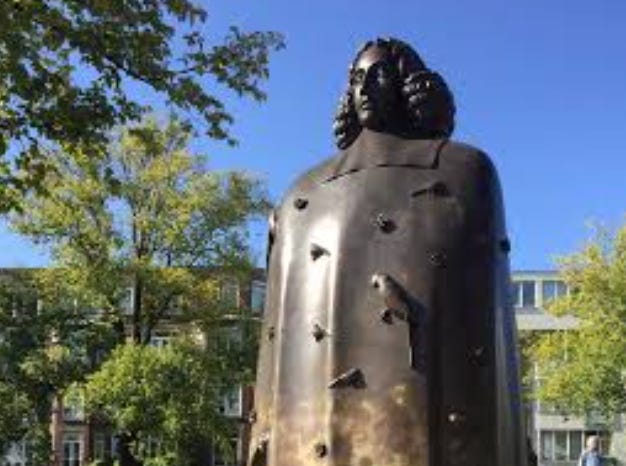
No-one could be more surprised than younger me, to find myself writing about philosophy, yet it’s the one thing that has most driven my studies and consequently my practice.
Firstly, I didn’t have that sort of education, nor have I found myself drawn to the history of philosophy. Secondly, it may seem as though philosophy has little place in this frightening and ever-changing world. And yet it’s everywhere. From Julian of Norwich memes to the philosophies underpinning the world order (or disorder), from daily lives to political systems, we stumble through systems, cultures, hierarchies and processes which are fundamentally philosophy driven. What most of us are not taught is to identify and interrogate what is shaping things.
What introduced me to philosophy was a single quote, by Antonio Gramsci:
“The crisis consists precisely in the fact that the old is dying and the new
cannot be born: in this interregnum, a great variety of morbid symptoms
appear.” (Gramsci, 1971)
I probably saw it on the internet, out of context, around twenty years ago and it may have been mistranslated to say something about monsters. I was likely studying for my teaching certificate, trying as so many of us were in those days to get my head around Gramsci’s idea of ‘cultural hegemony’. That didn’t quite stick, but the notion of ‘interregnum’ as a description of our times stayed with my practice.
I’ve been on quite a journey with Gramsci since then, not as a Marxist (he is usually described as a ‘Marxist philosopher’), more leaning into his idea of ‘philosophers of praxis’, which he ascribes to Marx and describes as, “a moment of modern culture” (ibid, p.391). Of course Gramsci’s ‘moment’ was a century ago and our times are very different.
And there’s the crux of it, as Gramsci himself recognised. Historical context is everything and fresh thinking is needed for our own ‘moment’, but that can and should draw on ideas from the past, as long as we are prepared to think through them for ourselves.
That identification of myself, however privately (at the time), as a ‘philosopher of praxis’ helped me think of myself as a thinker, not simply a parroter of conventional thinking. It made me brave. In turn, this has helped me draw on old ideas to generate new ideas and do new things. And that’s where philosophy sits with me. I don’t care that others will - and do! - argue differently about Gramsci’s meaning. I care passionately that reading some of Gramsci’s ideas propelled my thinking into different spaces, generating a praxis - thinking and doing - that is worthy of our times (Braidotti, 2014 p.182).
I don’t turn to Gramsci so often these days, but he’s always there, in the hinterland of my thinking. I can’t disentangle his impact then on what I think now. It’s to Rosi Braidotti (2013 p.164) that I owe the concept of ‘cartography’ as a “theoretically based and politically informed reading of the present”, which takes us beyond theory into developing new affirmative practices but which remains situated in all that has enlightened the thinking we have done until now.
What does this mean for educational research?
Our training as researchers usually happens as part of a formal programme of study (or, in my working context of adult and further education (AFE), alongside professional development in practitioner research). Which is to say, we are usually taught to adopt certain research paradigms, which in turn determine the methodologies we follow. Of course we (sometimes) have choice, but that choice is not usually to freewheel or try something epistemologically new. Rather we select and justify certain ‘off-the-peg’ methodologies; ethnography, phenomenology, action research, all worthy approaches and rooted themselves of course in certain philosophies.
We will find out new things (usually) and their newness is often very context-specific, particularly in close-to-practice research (Wyse et al, 2018). Again, nothing wrong with any of this. It is vital and it deepens our understanding of ourselves as research practitioners, the experts in our classrooms.
Yet education itself, in all its unexamined underpinning philosophies and fundamentally inscribed privileges and inequalities remains unprovoked by change. This may not be what you’re about, but I and others have chosen to follow paths into unimagined futures for education. A philosophical approach helps us to make what’s visible (systems, structures, hierarchies) get to one side for a short while as we grasp the philosophies underpinning them, and this enables us to briefly glimpse new possibilities.
It’s not a better approach, just a complementary one.
But is philosophy practical?
Not if you get stuck there, no. There is plenty of philosophical posturing out there, going round in circles. I still cringe to think of an article I wrote (and actually published!) when I was tussling with complicated thinkers during the lit review of my PhD. But as I started to weave my new thinking into my practice…that’s when things started to change.
Philosophical concepts which have guided me to the work I do now include:
Joy as a driving force, in every aspect of life and work. This came from Dutch philosopher Baruch Spinoza, writing in the 17th century. He believed that active joy is the force that propels us into our own agency. Joy met its moment at the beginning of Covid, when I co-founded the joyful educators’ network JoyFE and integrated joy as a practice into the professional development programmes I was designing at the time. It still infuses everything I do, uplifts me, gives me hope.
Joy led me to Spinoza’s twin concepts of potestas and potentia - a dual definition of ‘power’ that he had at his disposal, where potestas is the only definition we have in English and potentia something new - a joyful agentic changemaking power. Potentia became the central practice of Green Changemakers, the systems and culture change work I’ve been committed to for several years now.
I don’t read Latin and I found translations of Spinoza pretty dry, so I found my way in via bergman and Montgomery (2017), an activist book, Damasio’s (2004) search for the neurology of emotions and Carlisle’s news media articles about Spinoza (see, for example, 2011). No doubt Spinoza specialists could argue chapter and verse, but I took what I needed to co-design new national approaches to professional learning.
I am a generalist, an activist and a co-creator of community changemaking in the sector I love, so inevitably I encountered the famously obscure French philosophers Gilles Deleuze and Felix Guattari. Reading them through Braidotti (eg 2014), with whom I had the pleasure of studying over a number of years at her summer schools, I was able to re-draw professional learning in AFE as entangled and entwined rhizomatic networks, operating more like mushrooms than the hierarchical tree. Over time, this nature-infused lens led me to Donella Meadows’ (2017) systems change work and John Kotter’s (2014) leadership model of the dual operating system and the architecture of Green Changemakers.
Braidotti (2013) also introduced me to ‘figurations’, conceptual actors who ease new ideas into practice. So in my daily work, you’ll encounter the Bowerbird, Golden Unicorns, Constellations and Dancing Princesses, ways of seeing beyond what’s blocking us, to new thinking and doing..
My transdisciplinary journey took me down philosophical avenues, activist reading, leadership and management research, psychology and social policy and was inspired by slow journeys, nature connection, podcasts and many, many conversations (Mycroft, 2021). I can think of little that didn’t have some part to play in a cartography which has direct lines of flight into my practice today.
Final Thoughts
This is my story. Yours will be different.
I wrote this article because I wanted to bring philosophy alive for you, as a colour in the researcher’s palette which is sometimes misused or overlooked. It matters not because of what happened then, but what is happening now - in your practice, in organisations, in the world.
My journey into philosophy is an activist one, the desire to be ‘worthy of our times’ (Braidotti, 2014 p.182). So I will leave you with another philosopher, Friedrich Nietzsche - a man whose work generates limitless controversy but who left us with another resonant Latin term. Amor fati is originally found in the work of the Roman Stoic philosophers such as Marcus Aurelius. It means ‘love of one’s fate’, the idea that life should be lived joyfully and without regrets. I once misunderstood the plot of a novel because I didn’t understand what the term meant, but once I figured it out it settled into my bones. So I live as a philosopher with amor fati and the evidence of my practice ripples out that joy into the lives of many of those I encounter in my work.
bergman, C. and Montgomery, N. (2017). Joyful Militancy: Building Thriving Resistance in Toxic Times. Edinburgh. AK Press.
Braidotti, R. (2014). Writing as a Nomadic Subject. Comparative Critical Studies 11.2–3 (2014): 163–184 Edinburgh University Press DOI: 10.3366/ccs.2014.0122
Braidotti, R. (2013). The Posthuman. Cambridge. Polity Press.
Carlisle, C. (2011). Spinoza Part 1: Philosophy as a Way of Life. The Guardian 7.2.2011. Available online: https://www.theguardian.com/commentisfree/belief/2011/feb/07/spinoza-philosophy-god-world
Damasio, A. (2004). Looking for Spinoza. London. Vintage.
Gramsci, A. (1971, reprinted 2003). Selections from the Prison Notebooks. Translated by Geoffrey Nowell Smith and Quintin Hoare. London. Lawrence and Wishart.
Meadows, D. with Wright, D. (ed) (2017). Thinking in Systems: A Primer. Vermont. Chelsea Green Publishing Ltd.
Mycroft, L. (2021). Strange Times: The Creation of a Nomadic Community Education Imaginary. PhD Dissertation. Available online: https://eprints.hud.ac.uk/id/eprint/35563/
Wyse, D., Brown, C., Oliver, S. & Poblete, X. (2018). The BERA Close-to-Practice Research Project: Research Report. London: British Educational Research Association. Available online: https://www.bera.ac.uk/researchers-resources/publications/bera-statement-on-close-topractice-research
This is beautiful, Lou. Sometimes the ideas that don’t 'fit' are the ones that open the door to deeper thought. 💜🙏
Thanks for enlightening me Lou - your writings always help me understand better something I am thinking about. On this occasion it’s the link between love of one’s fate and joy. I am currently grappling with two changes in my life - one imminent and rather prosaic, measured in months and the other more significant and likely to unfold over months and years. Earlier in the year you introduced me to “Take courage” and now I am embracing Find Joy. Thanks again!